
The Tiny Terror: Spiny Waterflea in the Great Lakes

In the vast expanse of the Great Lakes, some of the most profound ecological changes are driven by invaders barely visible to the naked eye. The Spiny Waterflea (∗Bythotrepheslongimanus∗), a microscopic crustacean, might seem insignificant compared to the sprawling mats of Phragmites or the massive bodies of carp. Yet, this tiny predator has unleashed a cascade of effects throughout the Great Lakes’ food web, fundamentally altering the energy flow from the microscopic level upwards, and creating headaches for recreational users.
An Eastern European Hitchhiker: Who Are They and How Did They Arrive?
The Spiny Waterflea is native to the cold, freshwaters of Northern Europe and Asia, particularly regions around the Baltic Sea. Like many of the Great Lakes’ most damaging invaders, its journey across the Atlantic was facilitated by ballast water in transoceanic ships.
It was first detected in Lake Huron in 1984. From there, it rapidly spread to all five Great Lakes by 1987, demonstrating its ability to quickly establish and colonize new environments. Its microscopic size and hardy nature make it an ideal “hitchhiker” not just in ballast tanks, but also on fishing gear, boat hulls, and in bait buckets, enabling its spread into many inland lakes connected to or visited by Great Lakes boaters.
A Spiny Success: What Makes Them Effective Invaders?

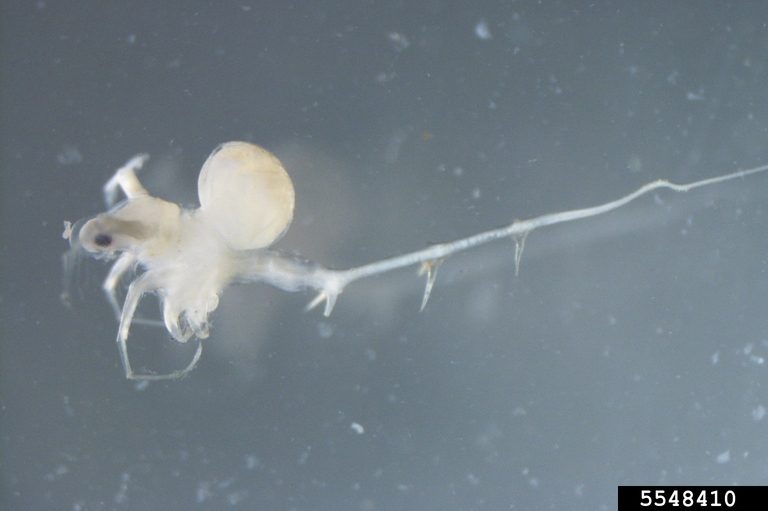
Despite their small size (typically 1-1.5 cm, with a tail spine accounting for up to 70% of their body length), Spiny Waterfleas are highly successful invaders due to several key characteristics:
- Voracious Predators: They are efficient predators of smaller, native zooplankton, particularly Daphnia species, which are often referred to as the “grazers of the lake” for their role in consuming algae and forming a critical food source for many fish.
- Defensive Spine: Their most distinctive feature is a long, barbed tail spine. This spine makes them very difficult for small native fish, especially larval and juvenile fish, to swallow and digest. Fish often attempt to eat them but then spit them out, expending energy without gaining nutrition.
- Rapid Reproduction: They can reproduce rapidly through parthenogenesis (asexual reproduction), meaning female Spiny Waterfleas can produce offspring without a male. This allows populations to explode quickly from just a few individuals. They also produce resting eggs that can survive harsh conditions, including passing through fish digestive tracts or drying out, contributing to their spread.
- Adaptability: They are tolerant of various water temperatures and conditions, allowing them to thrive across diverse parts of the Great Lakes.
The Bottom-Up Breakdown: What Harm Are They Doing?
The impacts of the Spiny Waterflea, though originating at the base of the food web, cascade upwards with significant consequences:
1. Food Web Disruption and Native Zooplankton Decline:
The most critical ecological impact is the direct predation on and competition with native zooplankton. By consuming large quantities of Daphnia and other native zooplankton, Spiny Waterfleas reduce the primary food source for many native larval fish (like yellow perch and walleye) and small invertebrate-eating fish. This effectively starves out the very young of our most important fish species, leading to slower growth rates and reduced survival for these critical early life stages.
“They are voracious predators of our native zooplankton, and they can essentially restructure the base of the food web,” explains Dr. Andrea Miehls, a research fishery biologist with the U.S. Geological Survey (USGS) Great Lakes Science Center. Her research has shown how the Spiny Waterflea’s unique adaptations, including their spine and reproductive strategies, contribute to their dominance and impact on fish diets.
2. Impact on Fish Growth and Survival:
When native fish try to eat Spiny Waterfleas, their barbed tails can get lodged in the fish’s digestive tract, causing injury or preventing digestion. This means that even if fish eat them, they may not gain nutritional benefit, further exacerbating food shortages. Reduced food availability at early life stages can translate into smaller adult fish and ultimately, smaller fish populations.
3. Nuisance for Anglers:
For recreational anglers, the Spiny Waterflea is a significant nuisance. Their barbed tails cling to fishing lines, downrigger cables, and nets, forming sticky, gelatinous clumps that can jam rod eyelets, damage reel drag systems, and generally make fishing frustrating and ineffective. These “blobs” can also spread the invader to new water bodies.
4. Ecosystem Service Loss:
By altering the zooplankton community, Spiny Waterfleas can indirectly impact water clarity and nutrient cycling. A healthy zooplankton community plays a role in controlling algal blooms, so their decline can have broader implications for water quality.
Science on the Spine: Who is Studying and Fighting Them?
Given their widespread distribution and the difficulty of controlling microscopic organisms in vast water bodies, research and management efforts for Spiny Waterflea focus heavily on understanding their ecology and preventing further spread.
- U.S. Geological Survey (USGS) Great Lakes Science Center: Researchers like Dr. Andrea Miehls at USGS actively study the Spiny Waterflea’s population dynamics, feeding ecology, and impacts on fish growth and survival. Their work helps understand the cascade effects on the Great Lakes food web.
- Sea Grant Programs (e.g., Michigan Sea Grant, New York Sea Grant, Wisconsin Sea Grant): These programs are key in public education and outreach. They provide critical information to boaters and anglers on how to properly clean, drain, and dry their gear to prevent the spread of Spiny Waterflea (and other microscopic invaders) to uninfested inland lakes.
- Academic Researchers: Universities throughout the Great Lakes basin (including Michigan State University, Cornell University, and the University of Wisconsin) conduct studies on their reproductive strategies, genetic diversity, and long-term ecosystem impacts.
- State Natural Resource Agencies: Agencies monitor Spiny Waterflea populations and work on public awareness campaigns to slow their spread.
While the Spiny Waterflea may be small, its impact is anything but. It serves as a potent reminder that even the tiniest invaders can trigger monumental changes, demanding our constant vigilance and proactive measures to protect the integrity of our deep world.
If you like content like this, please subscribe to our blog